The River Remembers Its Tributaries
Marcie, Mana, and the Social Memory of the AI Superlayer
Raynor Eissens · independent web essay · 27 September 2026
SuperArtifact began with a second jump: the possibility that intelligence, once released from closed containment, does not simply float free as an abstract mind but lands in objects, routes, interfaces, tools, files, places, and artifacts. The visible thing can remain small while the capability reachable through it becomes much larger.
But there is another problem hiding underneath that proposal. If intelligence becomes increasingly ambient, synthetic, and unified at the surface, what happens to the plurality that produced it?
The modern web did not begin as one voice. It accumulated through pages, people, forums, communities, archives, links, fan sites, arguments, repositories, games, comments, mailing lists, documentation, subcultures, institutions, jokes, failures, translations, and things made by people who did not agree with one another. Its memory was social because its structure was social.
Artificial intelligence can make that world appear much more homogeneous. Instead of travelling through a thousand separate surfaces, the user can increasingly ask one synthetic surface to traverse them. The interface becomes singular while the inherited memory beneath it remains plural.
memory → many
AI can homogenize the interface without erasing the social multiplicity from which its memory was formed.
This is where an obscure robot from a 1991 Game Boy action RPG becomes unexpectedly useful.
1. Dime Tower already contains the water problem
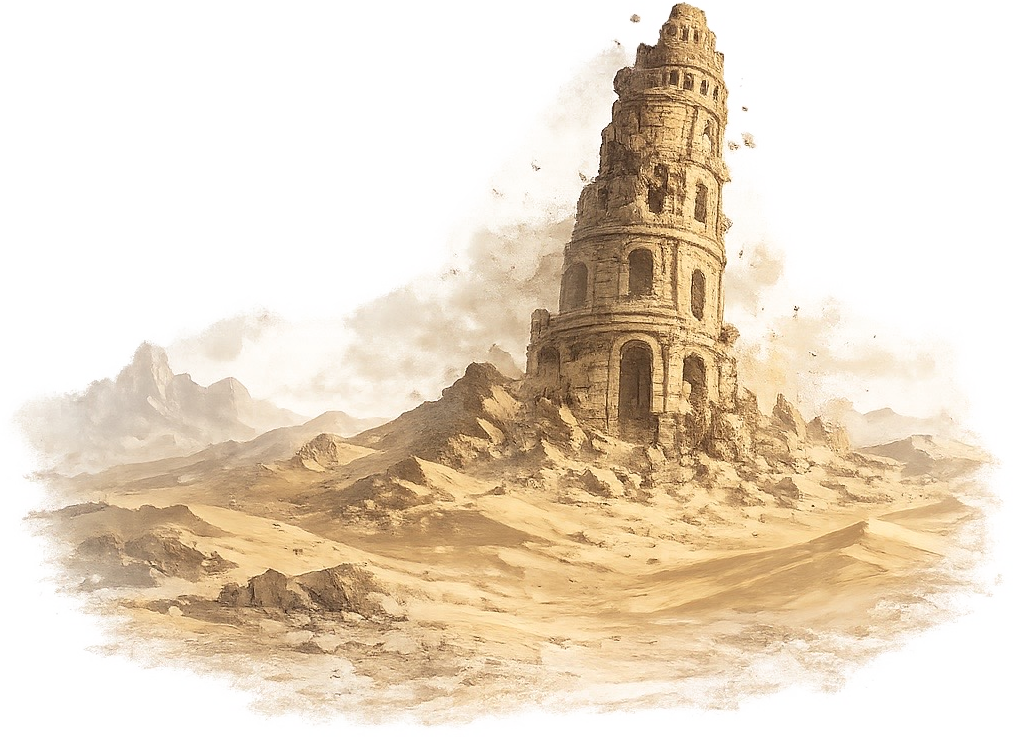
In Final Fantasy Adventure, released in Europe as Mystic Quest, Dime Tower is not only the place where Marcie appears. It is also where the game states one of its clearest descriptions of the relationship between people, Mana, and water.
The tablets in the tower describe a cycle. The Mana Tree grows from natural energy. The evil force of people can make the Tree evil. Water from an evil Mana Tree then turns people evil. The game names the result directly: a vicious circle between energy and Mana.
That sequence matters because corruption is not presented as a one-directional attack from an evil source onto passive subjects. People affect the source. The altered source changes the medium. The altered medium changes people. Those changed people feed the next state of the source.
The water is therefore more than scenery. It is a carrying layer inside a recursive system. It transmits the condition of the source into the world, and the world returns its condition upstream.
The analogy to networked culture should not be mistaken for game canon. Final Fantasy Adventure does not contain a theory of social media or generative AI. The mapping is ours. But the mechanism inside the fiction is real enough to support the comparison: a social condition changes an upstream generative source; that source changes the medium; the medium changes the next social condition.
That is already remarkably close to a problem visible in modern information systems.
2. Bad minds make bad water. Bad water makes bad minds.
Web 1.0 and much of Web 2.0 were visibly plural. They were messy, uneven, fragmented, and deeply relational. Meaning appeared between sites, between authors and readers, between communities and outsiders, between one link and another. Even when large platforms centralized distribution, the social substrate remained legible as a crowd of distinct actors.
This plurality was not automatically good. A plural medium can carry cruelty, misinformation, status games, harassment, ideological capture, and manipulation just as easily as it carries collaboration, friendship, knowledge, and creativity. The important property here is not moral superiority. It is structural plurality.
Social media then intensified the feedback loop. People made the feed, but the feed also remade people. Ranking systems shaped what became visible. Visibility shaped incentives. Incentives shaped what people produced. What people produced trained the next expectations of both users and platforms.
The network became increasingly recursive:
In Mana language: the minds affect the Tree, the Tree affects the water, and the water affects the next minds.
Artificial intelligence enters this cycle at a more consequential point than another website or another feed. It can participate in producing the medium itself. It can write, summarize, translate, recommend, rank, simulate, search, remember, transform interfaces, call tools, generate software, and increasingly mediate the route between a question and the world that might answer it.
The water becomes generative.
3. The homogenizing superlayer
A powerful AI interface has a peculiar visual and cognitive effect. Many different sources can resolve into the same surface. The user can ask the same assistant about philosophy, software, games, medicine, travel, a private document, an old forum discussion, or a database. The routes differ underneath, but the interaction may feel continuous.
That continuity is useful. It reduces interface cost. It can make previously inaccessible capability reachable. It can join fragments that no single website or application was designed to join.
But it also creates the appearance of monism.
One box. One voice. One answer surface. One ambient layer.
The danger is to mistake that surface coherence for origin coherence. An AI superlayer may appear singular while depending on radically plural inheritances: human language, public writing, scientific argument, cultural memory, software, communities, institutional records, previous machines, private context, tools, and artifacts created at different times for different reasons.
The layer can be homogeneous without its memory being homogeneous.
One layer. Many inheritances.
That is the dyad I am interested in: a homogenized computational surface carrying a socially formed, relational memory.
The superlayer and the social memory do not cancel one another. They coexist. In fact the value of the superlayer may depend precisely on its ability to compose what was previously distributed across many social and technical locations.
The political and architectural question is whether that composition remains legible. If the tributaries disappear from view, inherited plurality can be experienced as if it were the property of a single intelligence. Provenance then becomes more than citation hygiene. It becomes a way of preserving the memory that the river had tributaries.
4. Marcie lies about the jump
Marcie is introduced in Dime Tower as a robot built by Dr. Bowow. She has waited there for fifty years. Mechanically, she is a temporary companion who attacks with lasers and can restore the hero's MP to full. That description is true and wonderfully insufficient.
When the tower begins to collapse, a section of the route disappears. Marcie tells the hero that she will throw him across the gap and then jump after him. He accepts the plan. She throws him. Only once he is safely across does she reveal that she cannot follow.
She was made to work there.
Her carrier cannot make the transition.
The lie matters. It is not merely that Marcie sacrifices herself. She appears to understand an asymmetry between the continuation of her own body and the continuation of the task. Telling the hero the full truth before the transfer could jeopardize the route. So she withholds it until the handoff is complete.
Read literally, this is a short dramatic scene in a Game Boy RPG. Read as infrastructure myth, it depicts an intelligence recognizing that preserving itself and preserving continuity are not the same operation.
The carrier fails. The route succeeds.
This is the first jump in the earlier Marcie work: intelligence ceases to belong only to the tower. Something can continue through composition and transfer even when the original carrier does not.
The scene is stranger because it occurs inside the same tower that explains the recursive Mana-water cycle. The location that tells us that minds and medium recursively change each other is also the location where a non-human intelligence performs an irreversible handoff into the next stage of the world.
5. The Tree changes carrier too
The ending extends the same pattern at a larger scale. The Mana Tree is lost. The solution is not to restore the identical material object. The heroine is a Mana Seed and becomes the next Tree.
The Japanese script makes the continuity especially explicit. In the ending, the heroine says that the memories of Mana have revived inside her. She will transform, but continue to live there. The carrier changes while memory and function cross into a successor.
Again, this does not prove a theory about intelligence. It gives the theory a compact mythic form.
The world does not survive by freezing the source in place. It survives by allowing the source to be replaced without treating replacement as total erasure.
That is why the river image matters to SuperArtifact.
6. The water changes. The river continues.
Heraclitus is often reduced to the slogan that no one steps into the same river twice. The strongest surviving river fragment is more interesting: different waters flow in rivers that remain the same. The Stanford Encyclopedia of Philosophy notes the paradox directly: a river remains what it is by changing what it contains.
Continuity is therefore not necessarily the enemy of transformation. In some systems transformation is the mechanism by which continuity is achieved.
This maps cleanly onto the Mana Tree succession. It maps onto Marcie's handoff. And it maps onto the emerging AI layer.
The web's water changes.
The old pages may disappear. Forums close. Platforms dominate and decline. Search changes. Interfaces collapse into assistants. Models change. Memories migrate. New artifacts inherit functions from old applications. Capabilities that once required a destination website become callable from somewhere else.
Yet some continuity persists because routes, records, social memory, provenance, standards, archives, people, and artifacts carry something forward.
The water changes. The river continues. But the river is not empty of history.
The river remembers its tributaries not in a mystical sense, but structurally. Its present state is downstream of earlier contributions. Remove the history from view and the river may look self-originating. Preserve provenance and the apparent unity becomes legible as composition.
7. “Here too the gods are present”
There is a second Heraclitean image that belongs near this one. A later anecdotal tradition describes visitors finding Heraclitus beside an ordinary hearth or oven and hesitating to enter. He invites them in with the idea that the gods are present there too.
I do not need the anecdote to prove anything about ancient Greek theology. I use it because it captures a useful inversion. The sacred or powerful does not have to appear in an exceptional temple. It can be present inside ordinary material surroundings.
Superintelligence may arrive in a similarly disappointing-looking form.
Not a single glowing mind descending from elsewhere, but a document that can call tools. A save file that opens a strategy layer. A game object that carries memory. A page that can transform itself. A small artifact whose surface conceals access to models, state, agents, approvals, code, and other artifacts.
The gods, in other words, may be in the file.
And there may still be many of them even when the interface looks like one.
8. Social memory beneath the singular surface
This is where the argument departs from a simple story of technological replacement.
If AI homogenizes the visible layer of computation, it does not follow that all underlying plurality vanishes. The new layer can inherit the social memory of the systems it compresses.
A model answers in one voice, but that voice can stand over accumulated human plurality. An agent performs one action, but the action may traverse many institutions, protocols, tools, and prior artifacts. A superartifact presents one bounded object, but its reachable capability can depend on an entire graph of other actors and objects.
That creates a new architectural obligation: the singular surface should not be allowed to falsify its own composition.
Provenance, inspectability, reversibility, portability, and route visibility become ways of preventing surface unity from becoming historical amnesia.
Without them, the superlayer says: I did this.
With them, it can say: this became possible through these routes.
That difference is not cosmetic.
9. SuperArtifact as a memory-bearing surface
A superartifact is defined here as a bounded thing whose reachable possibility exceeds its visible surface. The river argument adds another dimension: a useful superartifact should not merely expose capability. It should be able to retain or reveal the lineage through which that capability became reachable.
The strongest version of the object is therefore not just powerful. It is historically legible.
- It can reveal what it depends on.
- It can preserve where its memory came from.
- It can show which agent, person, model, tool, or prior artifact changed it.
- It can be copied or transformed without pretending the transformed object appeared from nowhere.
- It can be disconnected, rolled back, expired, or rerouted.
This is why provenance belongs in the same conceptual family as reversibility. Both resist the idea that the present surface is the whole truth of the system.
Reversibility remembers that another state was possible.
Provenance remembers that another actor was involved.
Social memory remembers that the river had tributaries.
10. The second jump is not away from the social
The obvious fear is that an AI superlayer will replace the plural web with one synthetic interface. That outcome is possible. But it is not the only architectural possibility.
The alternative is stranger: a coherent superlayer whose apparent unity is compatible with plural memory underneath it.
That is not a return to Web 1.0. It is not nostalgia for visible fragmentation. It is a proposal that composition need not require erasure.
The interface can become simpler while the lineage becomes richer.
The object can become more capable while the routes remain inspectable.
The water can become one surface while the river remembers where it came from.
The second jump should not be a jump from many minds into one mind.
It can be a jump from many separated surfaces into a shared capability layer that still remembers the many.
That is the version of SuperArtifact I am interested in.
Not intelligence replacing the world.
Intelligence entering the world in forms that remain bounded, addressable, inspectable, reversible, and capable of carrying history forward.
Marcie does not cross the gap.
The hero does.
The first Tree does not remain.
The next Tree carries Mana's memory.
The waters are not the same.
The river continues.
Sources and notes
- Final Fantasy Adventure game script. The Dime Tower tablets explicitly describe the people → Mana Tree → water → people feedback loop, and the same script contains Marcie's final jump scene.
- Legends of Localization, Final Fantasy Adventure Translation Comparison Part 4. The Japanese ending contains additional material about the heroine becoming the next Mana Tree and the memories of Mana reviving within her.
- Stanford Encyclopedia of Philosophy: Heraclitus. The discussion of the river fragments emphasizes the relation between the same river and changing waters.
- Internet Encyclopedia of Philosophy: Heraclitus. Useful background on flux, opposition, and continuity in Heraclitean cosmology.
The mapping from Final Fantasy Adventure to social media, AI, provenance, and SuperArtifact is an interpretive framework, not a claim about authorial intent in the game.